
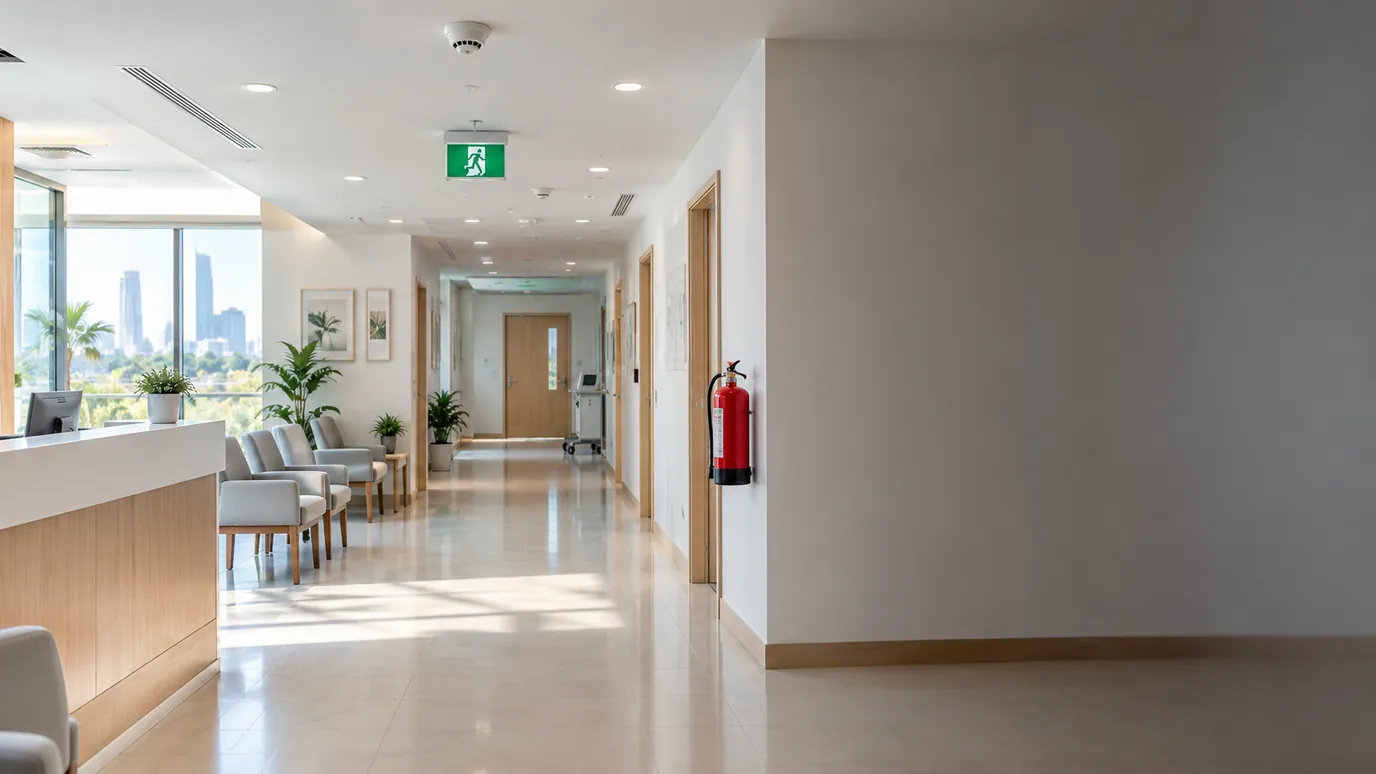
FM-200 fire suppression systems for hospitals in Riyadh, supplied and installed
The Civil Defense hospitals regulation requires an automatic system using agents other than water in special-hazard areas where water cannot be used.
TALS supplies and installs FM-200 and clean-agent systems for hospital server rooms, medical records and equipment rooms in Riyadh and across Saudi Arabia.
What we deliver
- Supply and installation of FM-200 and clean-agent systems from multiple international brands.
- Design and agent quantity calculations by our in-house engineering team to NFPA 2001 / ISO 14520.
- Detection, control and release panel, linked to the hospital fire alarm and HVAC shutdown.
- Room integrity (door fan) test before handover.
- Maintenance contracts, and cylinder refills for our own projects.
- Replacement of old Halon and old FM-200 systems.
- Works planned around live clinical operations.
The official requirement
«جدول (١): معدات مكافحة الحريق في المستشفيات — «٣- الأنظمة التلقائية الثابتة … ب- شبكة تلقائية لمرشات مواد أخرى»: «أماكن الخطورة الخاصة حيث لا يمكن استخدام المياه».»Table 1, fire-fighting equipment in hospitals — fixed automatic systems: "an automatic network discharging other agents" is required in "special-hazard areas where water cannot be used".
Sector specifics
- Typical rooms: IT/PACS server rooms, medical records stores, X-ray and MRI equipment rooms, electrical and mechanical rooms. The Ministry of Health's 2018 consultant prequalification listed X-ray and MRI rooms and electrical and mechanical rooms among the spaces whose protection was to be assessed; the system for each room is a design decision.
- Usual agent: a clean agent such as FM-200 (HFC-227ea) or FK-5-1-12. It leaves no water or residue, does not conduct electricity, and the manufacturer describes FM-200 as safe for occupied spaces within NFPA 2001 limits.
- Unoccupied electrical plant rooms: CO2 may be the choice there, with lock-out and a pre-discharge delay.
- Safety logbook: we record every inspection and service so the hospital safety officer can keep the Civil Defense logbook up to date.
Questions procurement teams ask
Does Civil Defense require a non-water system in hospitals?
Yes, in special-hazard areas where water cannot be used: Table 1 of the hospitals regulation asks for "an automatic network discharging other agents". It does not name FM-200; the agent is chosen in design.
Has the Ministry of Health procured gas suppression before?
Yes. In January 2018 the MOH announced it would qualify contractors to implement "Gas Fire Suppression System (NOVEC1230 & CO2) at health facilities across the Kingdom", to NFPA 2001 with a room integrity test for every protected room.
3M stopped making Novec 1230. What about our existing system?
3M completed its exit from PFAS manufacturing at the end of 2025 (3M 10-K, 2026). The same molecule, FK-5-1-12, is still made by other manufacturers; we assess your system and propose a suitable refill or replacement.
What is a room integrity test and why is it needed?
A door fan test measures how much air leaks from the room, to confirm the agent holds its concentration after discharge. The MOH's 2018 scope required it for every protected room, per NFPA 2001.
Who records inspections and maintenance?
The hospital safety officer, in the "Safety, Alarm and Fire-Fighting Equipment Log" stamped by Civil Defense, which records monthly checks and periodic tests (hospitals regulation, Article 8).
Do you work outside Riyadh?
Yes. We supply and install FM-200 and clean-agent systems in Riyadh and across Saudi Arabia.